ArticlesNight Shift → Sleep
Can’t Sleep After a Night Shift? How to Decompress After Work
Exhausted after nights but can't sleep? Why daytime sleep is harder, and practical options for nurses with real lives: kids, commutes and rotating schedules.
 Written by Boris, a registered nurse with 10+ years of shift work · 6 min read · Updated
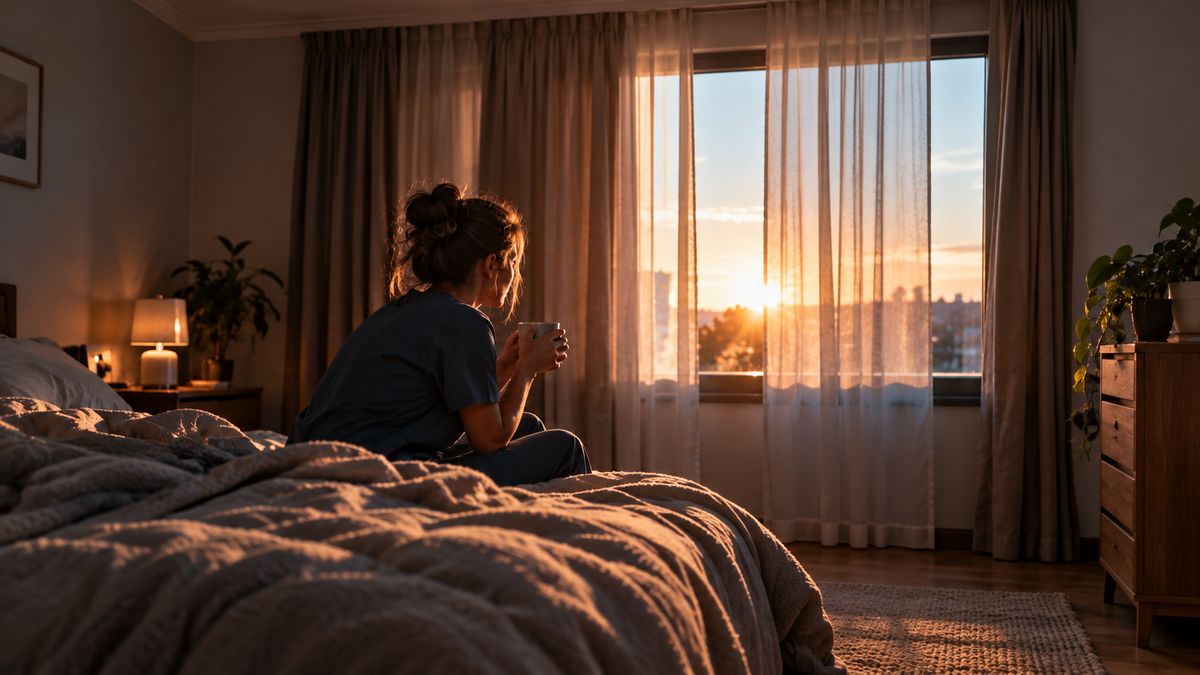
It’s 8:15. You’ve been awake for more than 24 hours. You pull the curtains, lie down, and you’re out.
Then it’s 11:40 and you’re wide awake. The garbage truck, a delivery, the neighbor’s dog. Or nothing at all. You’re exhausted, but your body has decided it’s the middle of the day.
Or it goes the other way. You get home wired, still running through the shift, and lie there staring at the ceiling.
Both are common after nights. Here’s why daytime sleep is harder, and some practical options. None of them assume you have a silent house, no kids and a perfect schedule.
Why sleeping after nights is harder
Two systems drive sleep.
Sleep pressure builds the longer you’re awake and drains while you sleep (NIOSH). After a night shift, it’s very high. That’s why many nurses fall asleep fast in the morning.
Your body clock (circadian rhythm) runs on a roughly 24-hour cycle and pushes you towards being awake in the daytime. It doesn’t fully flip just because you work nights.
After a night shift these two work against each other. According to NIOSH’s training for nurses, night workers often fall asleep quickly because sleep pressure is high. But as the body clock’s drive for wakefulness rises during the day, sleep can break up. Noise or minor discomfort can wake you more easily (NIOSH).
So the 11:40 wake-up isn’t a personal failing. It’s partly your biology doing what it does in daylight.
Three other things tend to make it worse:
- Light. Light is a major signal to your body clock (NIOSH). A bright morning commute and a half-dark bedroom tell it “daytime”.
- Noise and interruptions. Daytime is when the rest of the world is loud, and when family, phones and doorbells need you.
- No transition. Walking out of a busy night straight into bed, still keyed up, is a big jump. (More on switching off in Can’t Switch Off After a Nursing Shift?)
NIOSH also notes that night workers usually get less sleep overall, and poorer-quality sleep, than day workers (NIOSH). If you feel short-changed after nights, you probably are.
Practical options (not rules)
There’s no single right night-shift sleep schedule. It depends on your schedule, your commute, who lives with you and what you’re responsible for. Take what fits.
1. Treat the way home as the start of sleep
Keep the trip home low-key where you can. Some nurses wear dark sunglasses to cut down bright morning light. Evidence for that specific trick in nurses is limited, but it’s cheap to test.
If you’re drowsy, don’t drive. NIOSH describes the end of a night shift as the time of highest risk for sleepiness (NIOSH). A short nap before driving, a lift, or public transport are all better than pushing through.
2. Keep the wind-down short
NIOSH suggests going to sleep as soon as you can after a night shift, and says the more sleep you get before about 2 p.m., the better rested you’re likely to be. It also suggests not using that early-morning window for chores or errands (NIOSH).
That doesn’t mean you can’t decompress. It means keeping it brief and low-light: a shower, something to eat, a few minutes of something calm, then bed. A two-hour scroll on the couch pushes sleep into the part of the day when it’s hardest to hold on to.
If you have a school run, the ideal isn’t possible. That’s fine. Aim for the next-best version, like sleeping straight after the drop-off rather than doing chores first.
3. Make the bedroom properly dark
NIOSH’s guidance is blunt: dark enough that you can’t see your hand in front of your face, or wear an eye mask. That means blackout blinds or curtains and blocking light under doors. Keep the path to the bathroom dark too, with a dim red nightlight if needed (NIOSH). Cover or remove glowing clocks and screens (NIOSH).
If you do one thing from this article, test this. A cheap eye mask is a two-minute experiment.
4. Deal with noise before it deals with you
Earplugs, a white-noise machine or app, a fan. Put your phone on do-not-disturb with only the contacts who truly need you set to get through (NIOSH).
5. Make a deal with your household
The people you live with can protect your sleep or wreck it. NIOSH recommends getting cooperation from family and friends so they don’t disturb you (NIOSH).
In practice that might mean:
- a shared calendar showing your sleep times
- a sign on the door
- agreeing who handles deliveries, school calls and the dog
- your partner doing the morning routine on your post-nights days, in exchange for something you take on later in the week
It’s easier to negotiate on a day off than at 9 a.m. on your way to bed.
6. If one long sleep isn’t happening, plan two
Many nurses can’t get one solid block. NIOSH suggests sleeping as much as possible whenever you have the chance, which can include napping (NIOSH).
A morning sleep plus a nap before your next shift is a legitimate plan, not a failed version of the “real” one.
7. Think about your days off, too
Flipping fully back to nights-in-bed on days off, then back to nights at work, can leave you in something like permanent jet lag. One compromise NIOSH describes is keeping a few sleep hours the same every day. For example, on days off stay up later and sleep later, so some hours (say 8 a.m. to noon in their example) are always sleep time (NIOSH).
That won’t suit everyone, especially with young kids. It’s one option. Feeling wrecked on days off is common enough that we gave it its own article: Exhausted on Your Days Off?
What not to expect
- Nothing here makes daytime sleep as good as night sleep for most people. The body clock sets real limits.
- Some days the house, the kids or your own head will win. One bad sleep doesn’t mean the approach failed.
- None of this replaces sensible scheduling. How many nights you work in a row and how much rest you get after them matter. Much of that is outside your control.
When it’s more than a rough post-nights sleep
Post-shift sleep trouble is common. But talk to your doctor if:
- you regularly can’t sleep even when you have a quiet, dark opportunity to
- you’re struggling to stay awake at work or when driving
- sleep problems are lasting weeks and affecting your health, mood or safety
- someone has noticed loud snoring, pauses in your breathing or gasping in your sleep
These can have causes that deserve proper assessment, including sleep disorders. Talk to a clinician before starting sleep medication or supplements.
A small next step
Pick one thing from this list to test after your next set of nights. The eye mask, the phone setting or the household deal are good starting points. Watch whether you sleep longer before waking.
If you’d like a few more small things to try, the free 7-Day Shift Recovery Reset gives you seven practical experiments to try at your own pace. Each takes about 10 minutes or less and is designed around life on shifts. Use what helps. Ignore what doesn’t.
Free 7-Day Shift Recovery Reset
Small experiments that fit around nights.
Start with Day 1, then try Day 5 — Make sleep easier to reach: remove one obstacle between you and sleep and notice what changes. It’s a practical test, not a sleep treatment.
- Day 1Start where you are
- Days 2–6Choose what you need, in any order
- Day 7Choose your Keeper
Get the free 7-Day Reset
Seven experiments, 10 minutes or less each. Use what helps. Ignore what doesn’t.
The form didn’t load. Please refresh, or email contact@hellobetweenshifts.com and we’ll send the Reset.
No cardNo subscriptionInstant access
Your email is used to deliver the Reset. Ongoing emails only if you tick the box. Privacy
Between Shifts shares general recovery and wellbeing information. It isn’t medical advice, diagnosis, or treatment.
Sources
- NIOSH. Training for Nurses on Shift Work and Long Work Hours, Module 2: Sleep pressure (homeostatic sleep drive). DHHS (NIOSH) Publication No. 2015-115.
- NIOSH. Module 2: Desynchronization of homeostatic and circadian processes.
- NIOSH. Module 2: Sleep is a basic need (circadian rhythms).
- NIOSH. Module 6: Create a good sleep environment.
- NIOSH. Module 9: Coping with the night and evening shifts, sleep.
- NIOSH. Module 9: Coping with the night and evening shifts, sleep (continued).